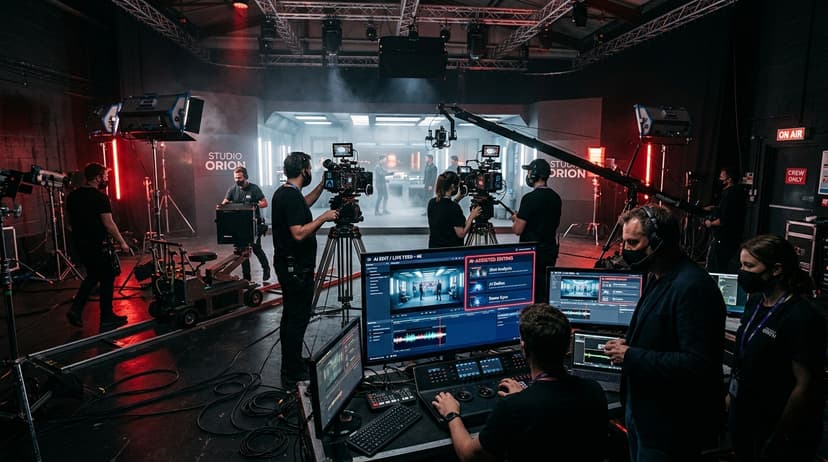
On-Stage Hardware & Sensor Calibration
Deploying Roe Visual Black Pearl 2.8mm: The Display Standard for High-Density Volumes across active virtual production soundstages demands microsecond-accurate hardware synchronization. In an In-Camera VFX (ICVFX) volume, latency or tracking drift immediately shatters the optical illusion of physical and digital parallax.
Stage technicians and tracking engineers configure rigorous calibration routines prior to principal photography:
- Genlock Precision: Locking camera sensor readouts, LED wall controllers, and Unreal Engine rendering nodes to a centralized blackburst or tri-level sync generator.
- Lens Mapping & Distortion Telemetry: Encoding continuous focus, iris, and zoom (FIZ) data alongside measured anamorphic optical distortion profiles.
- Frustum Optimization: Dynamic rendering that allocates maximum GPU compute exclusively to the inner frustum captured by the camera sensor, leaving outer wall fill at optimized refresh rates.
Unreal Engine & Telemetry Pipelines
Integration with real-time rendering engines like Unreal Engine provides instant feedback to directors and cinematographers:
```ini
[VP LiveLink Configuration]
Device Protocol: FreeD / Stype / Mo-Sys StarTracker
Update Rate: 120 Hz Synchronous
Optical Latency Offset: 1.2 Frames (Normalized)
Frustum Margin: 15% Dynamic Padding
```
By offloading complex real-time lighting calculations to hardware-accelerated stochastic ray-tracing clusters, the stage volume provides authentic environmental bounce lighting onto physical actors and practical set pieces, drastically reducing downstream post-production clean-up.
Directorial Verdict by Raja Rathna Reddy
The true strength of Roe Visual Black Pearl 2.8mm lies in how invisible the technology becomes to the creative team on set. When virtual production stages operate with zero tracking jitter and calibrated color fidelity, cinematographers can shoot with the same instinctive lighting choices they would make on a remote practical location.